I am José Galindo. This blog exists to challenge dogmas that for centuries were imposed on peoples as if they were absolute truth. Many of those ideas did not spread through the strength of reason, but through the weight of power, tradition, and, in other times, even by the sword. Here I analyze texts and doctrines to question what few dare to examine. If you seek to think for yourself and examine what others accept without asking, this channel is for you and will give you a guideline to detect even more lies than those I detected, and perhaps it will even encourage you to create your own blog to warn people who do not deserve to be deceived.
Videos
Teachings of Cleobulus of Lindos, a Greek thinker of the 6th century BC:
“Do good to your friends and to your enemies, for in this way you will preserve the former and be able to attract the latter.”
“Any man, at any moment in life, can be your friend or your enemy, depending on how you behave toward him.”
Teachings of Jesus Christ?
Matthew 5:44 “…do good to those who hate you, and pray for those who insult you and persecute you…”
Matthew 7:12 Therefore, whatever you want men to do to you, do also to them, for this is the law and the prophets.
The law and the prophets command to treat each person as he deserves; the wicked does not deserve good treatment according to the law:
Deuteronomy 19:18 And the judges shall inquire diligently; and if that witness is a false witness and has accused his brother falsely,
19 then you shall do to him as he thought to do to his brother; so you shall remove the evil from among you.
And if we speak of prophets, according to the prophet Nahum:
Nahum 1:2 “The Lord is a jealous and avenging God; the Lord is full of vengeance and wrath. He takes vengeance on his adversaries and reserves wrath for his enemies.”
Did Jesus really present God as an example to abandon the principle of “an eye for an eye”?
Matthew 5:45 “…so that you may be sons of your Father who is in heaven, who makes His sun rise on the evil and on the good, and sends rain on the just and on the unjust.”
According to Genesis 19:23–24:
“The sun was rising over Sodom, over the wicked (Genesis 13:13); shortly afterward, God rained fire and brimstone upon the wicked…”
Do not ask whether Jesus spoke of a different God; ask why Rome did so.
They preach: “Blessed are the poor… woe to you who are rich.”
But then they ask people for tithes, or sell them “sacraments,” and live like the rich.
And they also say: “Give as an act of faith.”
Faith in what? In God… or in the words of emperors behind the councils?
And tell me something else: do you consider it wise to offer the other cheek to the enemy?
If we say yes… then was “an eye for an eye” never wise?
Shall we say that God is perfect, but also that He makes mistakes and denies His own laws?
And meanwhile… do they not ask you for tithes while preaching “give to anyone who asks you”?
The false beggar is grateful for that teaching of the false prophet.
But the false prophet does not thank me for this teaching, because it exposes him.
Tell me, do you really believe that the desire of the righteous is that their wicked enemies strike them on the other cheek?
Matthew 13:47 Likewise, the kingdom of heaven is like a net that was cast into the sea and gathered fish of every kind;
48 and when it was full, they drew it ashore; and sitting down, they gathered the good into vessels, but threw the bad away.
49 So it will be at the end of the age: the angels will come forth and separate the wicked from among the righteous,
50 and will cast them into the furnace of fire; there will be weeping and gnashing of teeth.
Psalms 112:10 The wicked shall see it and be grieved; he shall gnash his teeth and melt away; the desire of the wicked shall perish.
No message, however wise and just it may be, pleases everyone; for some reason Rome persecuted one, did it not?
However, there are those who believe that this same message ceased to displease it and ended up becoming its official religion, as if Rome had changed…
If it did not change, then Rome spread the word of the slanderer, the word of Satan, because the word of God never pleased it.
Remove the wings from the false angel Michael and you will see a Roman legionary, sword in hand, saying:
“If you want protection, pray kneeling before my statue. Submit to our authority” (Romans 13:1),
“do not resist the evil we do to you” (Matthew 5:39),
and “if we take what is yours, do not demand it back” (Luke 6:30).
Do you really believe that Jesus said that, and not the empire that crucified him and then bore false witness against him?
Word of Zeus:
“Those who worshiped me ate pork (2 Maccabees 6, 2 Maccabees 2:7); that must not change… I will send my servants to say that Jesus and his followers said that eating pork no longer defiles a man (Matthew 15:11, Luke 10:9, 1 Timothy 4:1–5), and that he looked like me, so that my servants will continue to worship my image, for mine will say that his followers asked that he be worshiped (Hebrews 1:6, 2 Thessalonians 2). He came to fulfill the law and the prophets (Matthew 5:17–18). But I came to abolish the law and the prophets, and to usurp Yahweh, his God (Deuteronomy 4:3–8, Psalms 97:1–7, Exodus 20:3–5).”
Word of Satan:
“Love your enemy, so that the tyrant who robs you and worships my image may sleep peacefully.”
Friday, June 26, 2026
Don’t be deceived: God hears you directly—idols are just tools of religious merchants. The false prophet wants fame; the true prophet wants justice. It can't just be a coincidence.
"Don’t be deceived: God hears you directly—idols are just tools of religious merchants. The false prophet wants fame; the true prophet wants justice. It can't just be a coincidence.
An Innocent Child Challenges the Ritual of Guilt of the Mass //12
How can you fight the devil while loving your enemy, if the devil is the enemy? //65
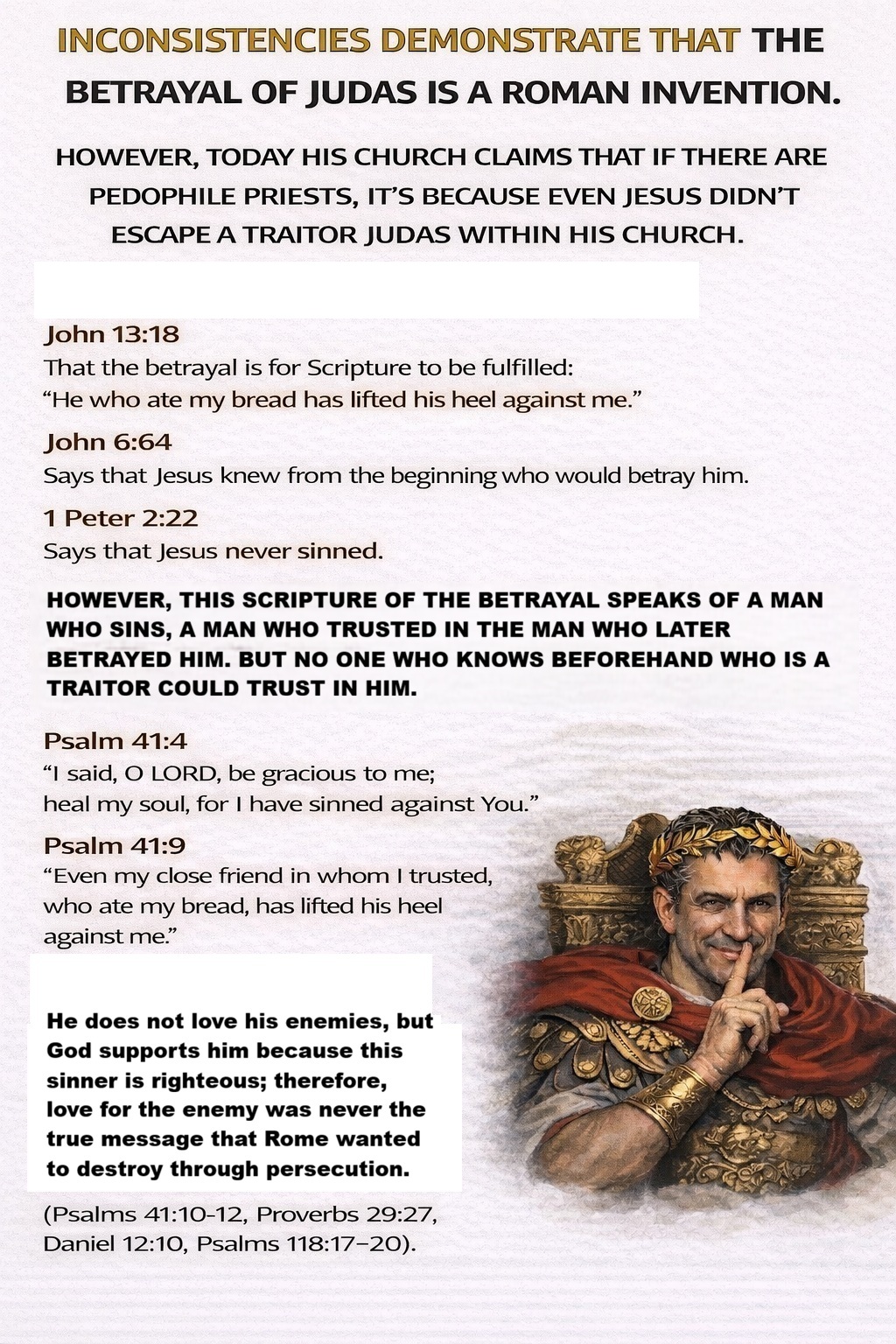
The betrayal of Judas is a false story. The inconsistencies show that the betrayal of Judas is a Roman invention. However, today their church claims that if there are pedophile priests, it is because not even Jesus could avoid having a traitor like Judas within his church. John 13:18 says that the betrayal occurs so that the Scripture may be fulfilled: 'He who eats my bread has lifted up his heel against me.' John 6:64 says that Jesus knew from the beginning who would betray Him. 1 Peter 2:22 says that Jesus never sinned. However, this Scripture about the betrayal speaks of a man who sins, a man who trusted in the man who later betrayed him. But no one who knows in advance who a traitor is could trust in him. Psalm 41:4: 'I said, Lord, be merciful to me; heal my soul, for I have sinned against You.' Psalm 41:9: 'Even my own familiar friend in whom I trusted, who ate my bread, has lifted up his heel against me.' He does not love his enemies, but God sustains him because this sinner is righteous; therefore, love for the enemy was never the true message that Rome sought to destroy through persecution (Psalm 41:10–12; Proverbs 29:27; Daniel 12:10; Psalm 118:17–20). //63
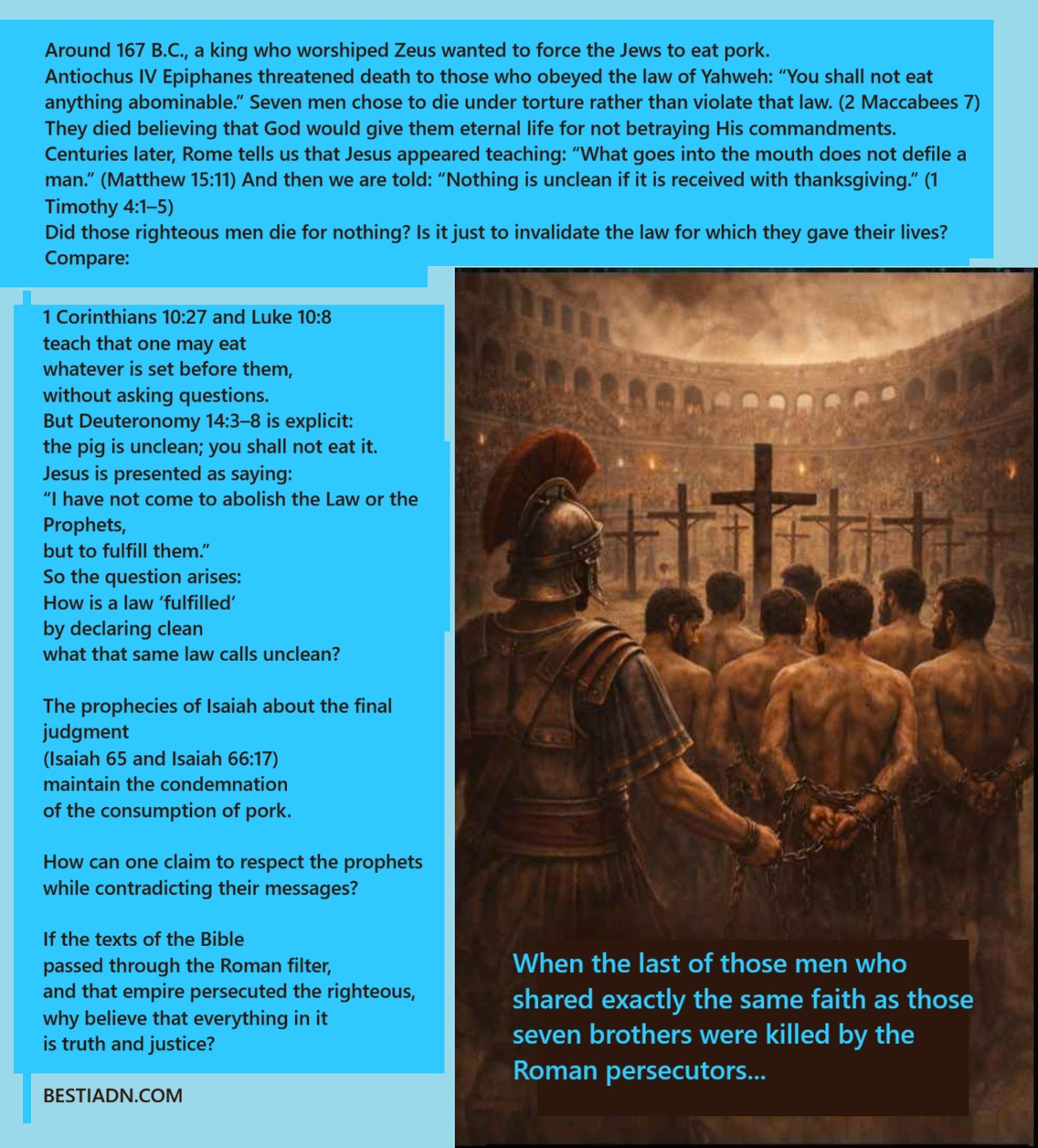
Around 167 BC, a king who worshiped Zeus wanted to force the Jews to eat pork. Antiochus IV Epiphanes threatened with death those who obeyed the law of Yahweh: 'You shall not eat anything abominable.' Seven men chose to die under torture rather than violate that law (2 Maccabees 7). They died believing that God would grant them eternal life for not betraying His commandments. Centuries later, Rome tells us that Jesus appeared teaching: 'What enters the mouth does not defile a man' (Matthew 15:11). And then we are told: 'Nothing is unclean if it is received with thanksgiving' (1 Timothy 4:1–5). Did these righteous men die for nothing? Is it just to invalidate the law for which they gave their lives? Compare: 1 Corinthians 10:27 and Luke 10:8 teach that one may eat whatever is set before them, without asking questions. But Deuteronomy 14:3–8 is explicit: the pig is unclean; you shall not eat it. Jesus is presented as saying: 'I did not come to abolish the Law or the Prophets, but to fulfill them.' The question then arises: how is a law 'fulfilled' by declaring clean what that same law calls unclean? The prophecies of Isaiah regarding the final judgment (Isaiah 65 and Isaiah 66:17) maintain the condemnation of eating pork. How can one claim to respect the prophets while contradicting their messages? If the texts of the Bible passed through the Roman filter, and that empire persecuted the righteous, why believe that everything they contain is truth and justice? BESTIADN . COM When the last of those men who shared exactly the same faith as those seven brothers was killed by the Roman persecutors… //138
"
No comments:
Post a Comment
Note: Only a member of this blog may post a comment.
No comments:
Post a Comment
Note: Only a member of this blog may post a comment.